2026
- Clinical trials Latest
First treatment day on a phase 1 trial
Miriam starts a phase 1 trial with BG-75202 combined with fulvestrant, at Vall d'Hebron's Early Drug Development Unit in Barcelona. It comes after months of closed doors and a long screening, with trips to Barcelona every few days.
See the BG-75202 trial →(opens in a new tab) - Outreach Latest
The case reaches episode 100 of Roca Project
Miriam's interview on Roca Project, Carlos Roca's podcast, is released as its special 100th episode, with her among the guests most voted for by the community. An hour and a half on the road to diagnosis, what metastatic breast cancer with neuroendocrine differentiation means, and why protocols don't cover all the genetics. Over the following days the website's contact form fills up: engineers, researchers, patients, and people who simply want to help.
Watch the full interview →(opens in a new tab) - Progression
The cancer leaves the bone: liver lesions appear
The trial screening imaging shows lesions in the liver. Until now the disease had been bone-only. Liver function remains within normal range, but the tumour is no longer confined to bone: it is spreading, and every month that passes narrows the window to find something that works.
- Clinical trials
The vaccine route closes
Both personalized vaccines under exploration fall through in the same week. One, because it requires measurable disease and Miriam's metastases are bone-only: an entry criterion that leaves out many patients like her. The other, because its last slot had just been filled. One of the two stays open should the situation change.
- Outreach
The metastasis map goes public
Miriam openly publishes the interactive map of her metastases: the tool that helps her team understand the case and decide, for example, where to biopsy. That same day, El Español tells her story. She shares it on X with great excitement.
See the announcement on X →(opens in a new tab) - Progression
A lesion threatening the spinal cord, and urgent radiotherapy
A follow-up MRI, after 73 days without treatment, shows clear bone progression and, above all, a lesion in the T11 vertebra starting to threaten the spinal canal: the risk of cord compression is real. Urgent SBRT radiotherapy is scheduled to shrink the lesion and protect the spinal cord.
- Outreach
helpmiriam.com at the M. Chiara Giorgetti Award, in Barcelona
Miriam presents the project at the M. Chiara Giorgetti Award ceremony —given by the Spanish Metastatic Breast Cancer Association for research into this cancer— held in Barcelona. Very well received.
About the M. Chiara Giorgetti Award →(opens in a new tab) - Molecular
The breast biopsy doesn't yield enough tumor
A breast biopsy is done to try to qualify for a trial that requires tumor tissue. The analyzable sample is tiny (0.3 mm), not enough to meet the criteria, so this route doesn't allow entry.
- Molecular
A new scan opens another door
Ga-68 DOTATOC PET-CT. Multiple blastic bone metastases with somatostatin receptor overexpression and focal uptake in the right breast tail. Confirms the tumor's "two sides" (luminal FGFR1/CCND1 + neuroendocrine RB1 + SSTR behavior) and opens the radioligand therapy path (PRRT).
See the Ga-68 PET thread →(opens in a new tab) - Molecular
Experts from several countries review the case
The WIN Consortium international molecular tumor board meets to review Miriam's case.
- Outreach
The problem with the Spanish protocols
Video explaining why Spanish protocols fall short for this profile and a call to spread the case.
Watch the video →(opens in a new tab) - Third line
The third line is offered
With the ESR1 resistance mutation (D538G) confirmed in blood, elacestrant is offered as a standard 3rd line (public funding approved), though it is never started. In parallel, clinical trials and the radioligand route (PRRT) are evaluated.
- Molecular
The tumor keeps changing
Second blood ctDNA on the Guardant360 CDx panel. Results: ESR1 D538G (0.84%), CCND1 amplified (6.83), FGFR1 amplified (5.86), RB1 V622Yfs*33 (0.19%) and the new SMO V319D (0.26%) — clinical significance uncertain, under watch.
- Molecular
The needle finds no tumor
The needle reaches the lesion, but the sample collected is bone tissue, not active tumor. Results: mineralized bone trabeculae and skeletal muscle fibers, with no neoplastic cells. This does not rule out disease — it only confirms that tissue profiling can't be done through this route. The molecular picture keeps coming from ctDNA in blood.
- Outreach
Talk at Codemotion Madrid
Miriam takes the stage at Codemotion Madrid to talk about how AI is helping advance her case. First public outreach event of the project and her return to the tech ecosystem after two years.
See the thread on Twitter →(opens in a new tab) - Molecular
A second reading confirms the profile
First blood ctDNA on the Guardant360 panel. Results: ESR1 D538G, 3 distinct RB1 mutations, FGFR1 amplified and CCND1 amplified.
- AI
Putting the whole case in writing
A complete clinical summary of the case is generated using advanced language models. The document is designed for international second opinions and to communicate the case to high-level specialists.
See documentation thread →(opens in a new tab) - Molecular
Reading the tumor without touching it
First plasma ctDNA, within a liquid biopsy trial. Baseline profile of the tumor without needing tissue. Results: ESR1 D538G detected and low MSI status.
- Team
The team forms and the search begins
Miriam begins researching her own case with artificial intelligence. A thread on Twitter. A few professionals who see it and say: I can help. Within days, a spontaneous multidisciplinary team forms with specialists from three countries.
See the original thread on Twitter →(opens in a new tab) - Progression
Bone progression
The PET-CT of 24 Mar 2026 confirms bone progression (more uptake in pelvis and right femur; new foci in D1 and left iliac). On 30 Mar abemaciclib —always at 100 mg— is stopped due to the progression and mild hepatotoxicity that normalized once withdrawn. Zoladex and zoledronic acid continue; the search for the next strategy begins.
2025
- Second line
A change of plan after progression
Following confirmed progression on PET-CT, second-line treatment begins: letrozole is switched to fulvestrant and ribociclib to abemaciclib. Zoladex continued.
2024
- Molecular
The tumor reveals its molecular identity
Miriam participates in the DIPCAN study, enabling a complete genomic analysis of the tumor (TSO500). The results reveal the key markers: FGFR1 amplified ×13, CCND1 ×20, FGF3/4/19 ×18 (11q13 cluster). The analysis also detects a striking discrepancy in the progesterone receptor (PR): the same tumor sample returns 5% at the local laboratory but 100% at the external reference laboratory — a difference with direct implications for hormonal treatment decisions.
- Urgent admission
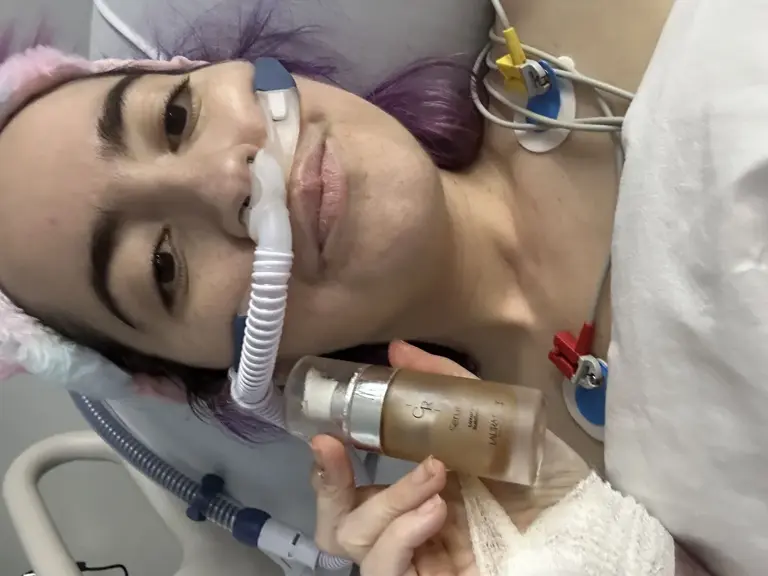
50 days hospitalized, 10 in ICU
The severe neutropenia caused by ribociclib led to bilateral necrotizing pneumonia with areas of pulmonary necrosis. Miriam is admitted to the ICU with severe respiratory failure, critically low platelet counts, and the need for high-flow respiratory support. Bronchoscopy, transfusions, and intensive antibiotic therapy are required. Total hospital stay exceeds 50 days. This was the most critical moment since diagnosis.
- First line
The first treatment begins
First-line treatment begins with letrozole, ribociclib, Zoladex (goserelin), and zoledronic acid. After the first cycle, Miriam is urgently admitted with acute respiratory failure. Ribociclib is permanently discontinued.
- Diagnosis
The result arrives by email
The MRI report arrives by email on a Thursday morning. The conclusion: "probable vertebral metastases." No doctor present. No context. Just a screen. That same day, Miriam is admitted to the emergency room. The following Tuesday she receives the full diagnosis: stage IV breast cancer with neuroendocrine differentiation, multiple bone metastases, and spinal cord compression at L3. She is 33 years old. That same Tuesday, radiotherapy begins on the affected vertebrae.
2023
- Symptoms
Back pain begins
Miriam begins to notice persistent lower back pain. Weeks of physiotherapy and consultations with no clear answer. Until she requests an MRI herself.
2021
- Background
A first warning that went unanswered
Miriam goes to the emergency room due to bleeding in the breast. An ultrasound is performed. The result is normal. And that's where it ends.
This timeline is updated weekly. You can follow the day-to-day in real time on X/Twitter.